
Two Powerhouse Fabrication Methods
When it comes to manufacturing scale model components, two technologies dominate: 3D printing and CNC machining. Each has distinct advantages, and at CoreModel, we use both — often in the same project. Here's how to decide which is right for yours.
3D Printing: Additive Manufacturing
Advantages
- Can produce extremely complex geometries that would be impossible with subtractive methods
- Fast prototyping — from digital file to physical part in hours
- Minimal material waste
- Ideal for small, intricate components like valve wheels, pipe fittings, and figure details
Limitations
- Surface finish often requires post-processing (sanding, priming)
- Limited material options compared to CNC
- Slower for large-volume production of identical parts
- Dimensional accuracy typically ±0.1–0.3mm
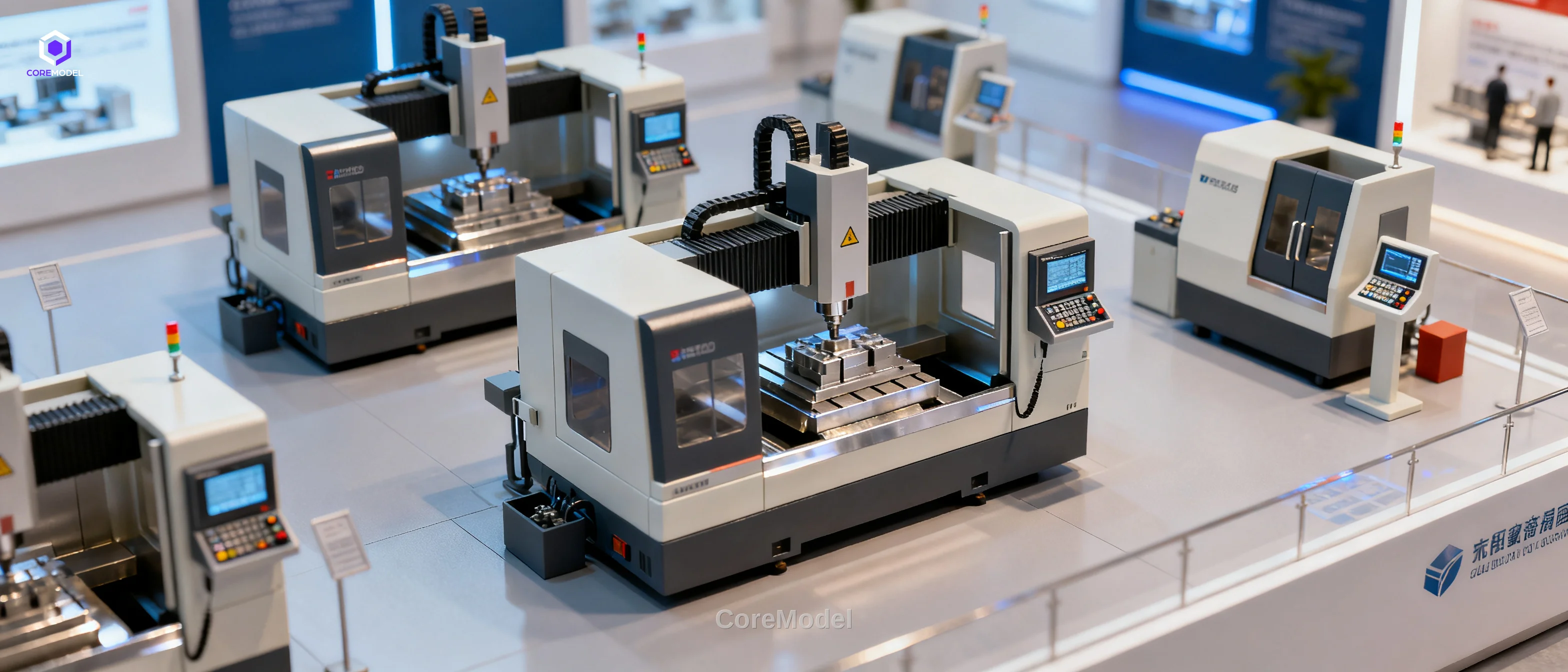
CNC Machining: Subtractive Manufacturing
Advantages
- Superior surface finish straight off the machine
- Works with a wide range of materials: metals, plastics, wood, foam
- Excellent dimensional accuracy (±0.01–0.05mm)
- Cost-effective for producing multiple identical parts
Limitations
- Cannot produce internal cavities or undercuts without multi-axis setups
- Generates material waste
- Tool access constraints on complex geometries
- Higher setup cost for one-off parts
Our Approach: The Right Tool for Each Component
At CoreModel, we don't believe in a one-size-fits-all approach. With 50+ 3D printers and a 300㎡ CNC & Laser workshop, we select the optimal method — or combination — for each component of your model. The result: maximum detail, minimum cost, and the fastest turnaround.