
Continuous Carbon-Fiber Nylon 3D Printing Service: A Game-Changer for Industrial Prototyping
In the fast-paced world of manufacturing, the demand for high-strength, lightweight, and durable components is skyrocketing. Traditional manufacturing methods often fall short when it comes to rapid prototyping or low-volume production of complex parts. This is where continuous carbon-fiber nylon 3D printing service steps in, offering a revolutionary solution that combines the design freedom of 3D printing with the mechanical performance of continuous fiber reinforcement.
As a leading scale model and sand table model manufacturer with over 15 years of experience, CoreModel has integrated this cutting-edge technology into our production capabilities. We serve clients across 80+ countries, delivering custom industrial dioramas, architectural models, and functional prototypes. In this article, we delve into the intricacies of continuous carbon-fiber nylon 3D printing, its benefits, applications, and why it is a superior choice for industries like aerospace, automotive, and logistics.
What is Continuous Carbon-Fiber Nylon 3D Printing?
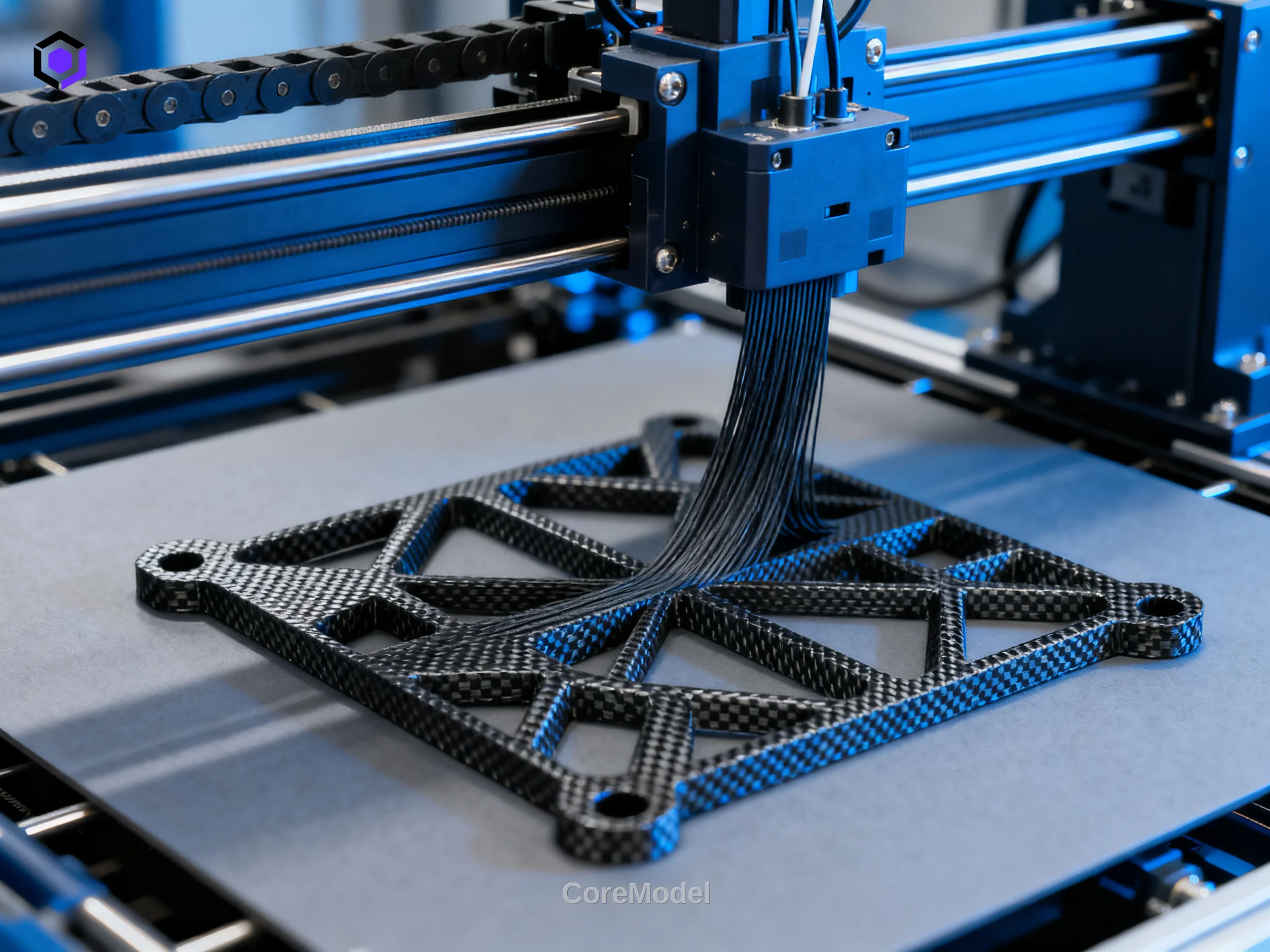
Continuous carbon-fiber nylon 3D printing is an advanced additive manufacturing process where continuous strands of carbon fiber are embedded within a nylon matrix during the printing process. Unlike chopped carbon fiber, which is mixed into the filament, continuous fibers run uninterrupted through the part, significantly enhancing its tensile strength, stiffness, and impact resistance. The result is a composite material that rivals aluminum in strength but at a fraction of the weight.
This technology is particularly valuable for creating functional prototypes, end-use parts, and tooling. It allows engineers to test components under real-world conditions without the cost and lead time associated with CNC machining or injection molding. Moreover, the ability to control fiber orientation enables anisotropic properties, meaning you can tailor the strength in specific directions to match load requirements.
Key Benefits of Continuous Carbon-Fiber Nylon Parts
Choosing a continuous carbon-fiber nylon 3D printing service offers a host of advantages over conventional materials and manufacturing methods:
- Exceptional Strength-to-Weight Ratio: Parts are up to 10 times stronger than standard 3D-printed nylon and significantly lighter than aluminum.
- Heat and Chemical Resistance: Nylon offers good thermal stability and resistance to oils, greases, and solvents, making it suitable for harsh environments.
- Design Flexibility: Complex geometries, internal channels, and lattice structures are possible without additional tooling.
- Rapid Turnaround: Prototypes can be produced in days, not weeks, accelerating product development cycles.
- Cost-Effective for Low Volumes: No expensive molds or tooling required, making it ideal for custom parts and small batches.
These benefits are why industries such as aerospace, defense, and robotics are increasingly adopting this technology for both prototyping and production.
Applications Across Industries
Our clients leverage continuous carbon-fiber nylon 3D printing in diverse ways:
Aerospace and Defense
From drone frames to satellite brackets, the weight savings and structural integrity are critical. Parts can be printed with optimized fiber paths to withstand extreme loads while minimizing mass.
Automotive and Motorsports
Custom jigs, fixtures, and even functional components like intake manifolds benefit from the high-temperature resistance and toughness of carbon-fiber nylon.
Industrial Machinery
End-of-arm tooling for robots, wear-resistant gears, and housing for sensors are common applications. The material's low friction and wear properties extend part life.
Architectural and Urban Planning Models
At CoreModel, we also use this technology to create durable, detailed scale models that withstand handling and transportation. The high resolution and strength allow for intricate details that would be impossible with traditional model-making.
How CoreModel Ensures Quality in 3D Printing Services
With over a decade of experience, CoreModel has refined its 3D printing processes to deliver consistent, high-quality results. Our state-of-the-art printers are equipped with dual extruders that precisely lay down continuous carbon fiber along with nylon filament. We conduct rigorous testing, including tensile strength and dimensional accuracy checks, to ensure every part meets industry standards.
Our team works closely with clients to optimize designs for additive manufacturing, considering factors like fiber orientation, wall thickness, and support structures. This collaborative approach ensures that the final product not only meets but exceeds expectations.
Comparing with Other 3D Printing Technologies
While standard FDM printing with nylon or plastic offers versatility, it lacks the mechanical properties needed for demanding applications. On the other hand, metal 3D printing provides ultimate strength but comes with high costs and longer lead times. Continuous carbon-fiber nylon strikes the perfect balance, offering near-metal strength at a fraction of the cost and time. For scale models, this means we can produce parts that are both visually accurate and physically robust.
Why Choose CoreModel for Your 3D Printing Needs?
CoreModel is not just a service provider; we are your strategic partner in innovation. Our global footprint, with clients in over 80 countries, is a testament to our reliability and expertise. We offer:
- Comprehensive services: From design consultation to post-processing, we handle every step.
- Fast turnaround: We understand tight deadlines and offer expedited services.
- Quality assurance: We adhere to strict quality control protocols.
- Customization: Every project is tailored to your specific requirements.
Whether you need a single prototype or a batch of functional parts, our continuous carbon-fiber nylon 3D printing service is ready to bring your ideas to life.
Future Trends in Continuous Fiber 3D Printing
The field of continuous fiber 3D printing is evolving rapidly. We anticipate advancements in multi-axis printing, allowing for even more complex fiber orientations, and the development of new matrix materials like PEEK and PEKK, which offer higher temperature resistance. These innovations will open doors to new applications, particularly in the medical and energy sectors.
As a forward-thinking company, CoreModel stays at the forefront of these technologies, ensuring our clients always have access to the latest capabilities.
Conclusion
Continuous carbon-fiber nylon 3D printing is a transformative technology that bridges the gap between prototyping and production. It offers an unbeatable combination of strength, weight savings, and design freedom. For industries that demand performance and reliability, this service is indispensable.
At CoreModel, we are committed to delivering excellence in every project. Contact us today to discuss how our continuous carbon-fiber nylon 3D printing service can accelerate your product development and give you a competitive edge. Visit our website at www.coremodel3d.com or reach out to our team for a consultation.